darpa’s cheetah

Just yesterday I received an e-mail from ↑Maurizio Teli [whom I know from back in 2005, when we met at the Cyberspace conference in Brno, Czech Republic] containing a call for papers for a workshop he is organizing together with ↑Vincenzo D’Andrea and ↑David Hakken. The workshop will take place at this year’s annual meeting, called ↑Design and displacement—social studies of science and technology, of the ↑Society for Social Studies of Science (4S), taking place 17 through 20 October 2012 in Copenhagen, Denmark. Here is the workshop’s full abstract:
In the last few years, the label “Social Computing” (SC) has been increasingly used to identify the ensemble of computing applications developed in order to foster and sustain social relationships. The use of the label seems to imply that SC is engaging with hybrid sociotechnical relationships, underlining a change in computer science. Nevertheless, SC is in line with the origin of computer science, in particular with the computing development program promoted in the ’50s by Norbert Wiener, aiming at promoting a society that increases the “human use of human beings”. However, although many applications are labeled “social computing,” they are mainly commoditized, to generate profit for corporations, and they focus on a restricted set of application domains. Such practical displacement of the societal view of Wiener calls for a deep reflection based on an empirical perspective able to frame SC through an STS lens, for two main reasons. Firstly, SC is an academic and social construction, and its design and foundational discourses can be understood and questioned through an STS lens. Secondly, the use of the term SC builds constraints on how innovation can take place in the social arena of SC. Along with these premises, an STS lens can increase the understanding of the hybrid relationships designed and displaced by SC academic practices, as well as overcoming the constraints of SC discourses providing conceptual and methodological tools to design new kind of SC technologies.
Taking this perspective, we ask for contributions addressing:
1) the academic and industrial construction of SC within and across disciplines;
2) the design of social relationships in SC initiatives and their displacement in SC use;
3) the engagement of STS researchers, lexicon, and methods, as a practice-based intervention in the design of SC technologies;
4) the facilitation of social inclusion in SC projects.
Deadline of submission is 18 March 2012, and all submissions have to be made via the ↑conference’s homepage—there you can also read the conference’s overall abstract/cfp and ↓download the abstracts/cfps [.pdf | 372KB] of all 106 open panels. Reading through these already is worthwhile, imho.
Speaking of worthwhile—once there I browsed a bit through the 4S website, and guess what I found under the label of ↑scholarly resources … ‘a ↑list of movies with significant STS themes, also submitted by members.’
As I am an anthropologist by profession, people oftentimes wonder because of the contents of my blog here—all that science fiction and especially cyberpunk stuff, not to mention the ↵cyberpunkish materials listings, especially the vast list of ↵cyberpunkish motion pictures [continuously updated, it again has grown significantly]. Well, I am trying to make a point and that way am collecting material for supporting my point, namely that a particular ilk of cultural products (those falling into what I call the cyberpunk discourse) are crucial for understanding contemporary society and culture.
As it seems the Society for Social Studies of Science is of similar opinion :-)
But back on topic: 1) Maurizio’s workshop goes well with the recently announced workshop ↵relocating science and technology, taking place in Halle/Saale, Germany, from 18 through 20 July 2012. 2) In respect to Maurizio’s workshop’s topic I’d like to hint at the work of ↑Matti Tedre, especially his ↓Ethnocomputing: A Multicultural View on Computer Science (2002) and ↓The Development of Computer Science: A Sociocultural Perspective (2006). Have a look at ↑all his publications, many of them available for download there.


Last Saturday ↑Ralph McQuarrie died age 82 in Berkeley, California. What ↑Syd Mead ↵is for ‘Blade Runner’ (Scott 1982), Ralph McQuarrie was for ‘Star Wars’ (Lucas 1977)—the decisive conceptual designer. McQuarrie gave us the whole look and feel of Star Wars and e.g. the now since long globally recognized iconic figures C-3PO, R2-D2, and of course Darth Vader.
As a kid I was blown away by his early sketches of these characters, and I still am today. To my eye they have a somewhat darker quality than the versions finally to be seen in the movies.
At the official website ↑The Art of Ralph McQuarrie there are numerous galleries showing off a plethora of concept drawings and paintings for the original Star-Wars trilogy and all the other projects McQuarrie has worked on.
zeph’s pop culture quiz #18

Why are the two gentlemen looking a bit off-balance, what is embarrassing in the scene depicted?
Just leave a comment with your educated guess—you can ask for additional hints, too. [Leaving a comment is easy; just click the ‘Leave a comment’ at the end of the post and fill in the form. If it’s the first time you post a comment, it will be held for moderation. But I am constantly checking, and once I’ve approved a comment, your next ones won’t be held, but published immediately by the system.]
UPDATE and solution (05 March 2012):
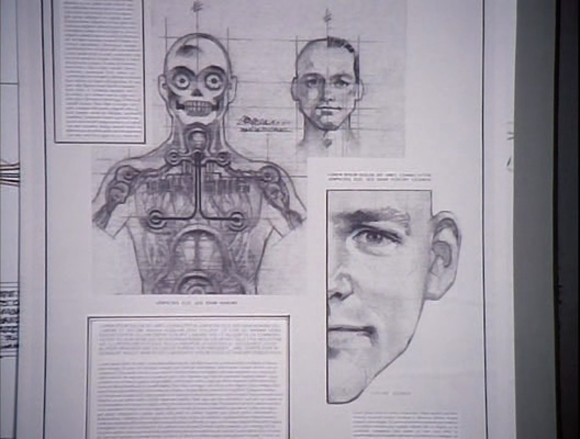
↑Kueperpunk was faster than lightning and ↵immediately solved the riddle: ‘I can’t remember what it was, but that’s “Prototype.” Guess it has something to do with the fact that the young guy is a robot.’ Congratulations! Yes, it is ‘Prototype’ (Greene 1983), and yes, the uneasy situation has to do with Michael (David Morse) being an android. It’s early in the movie, Dr. Carl Forrester (Christopher Plummer) has brought the prototype Michael home—without Forrester’s wife Dorothy (Frances Sternhagen) knowing. Forrester wants to see if Michael passes as a human. He does, but Dorothy serves dinner. Michael can’t eat, doesn’t want to be rude, but can’t tell that he is a machine either. Finally, when his wife goes into the kitchen for a minute, the doctor pours the salad from Michael’s plate upon his own. So, the artificial-intelligence equipped robot he constructed is a success. The military thinks so, too, but Forrester doesn’t like that … from then on drama unfolds. Again: Hardly known today, but very worthwhile watching.
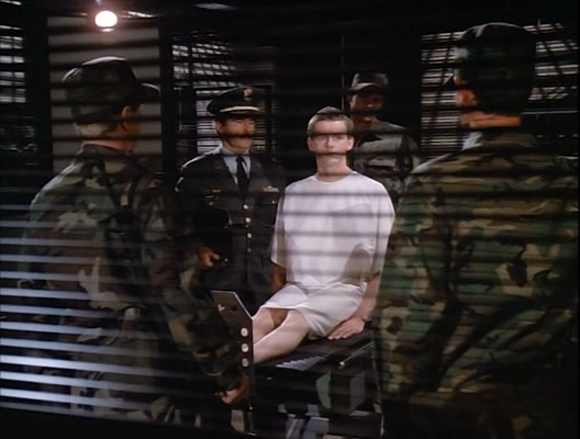

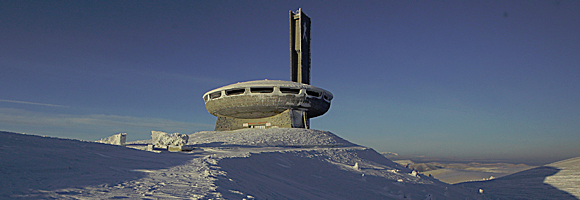

Last summer photographer ↑Timothy Allen met Alexander Ivanov, a colleague of his, at a photo festival in Bulgaria: ‘Back then he showed me some pictures of what looked to me like a cross between a flying saucer and Doctor Evil’s hideout perched atop a glorious mountain range.’ This winter Timothy went there, 250km from Sofia, and took ↑glorious pictures of the Buzludzha monument, a gigantic, now abandoned and decaying monument to socialism. The pictures show the building from the outside, the inside, and even from the sky. Goes well with the ↵cosmic communist constructions photographed by Frédéric Chaubin.
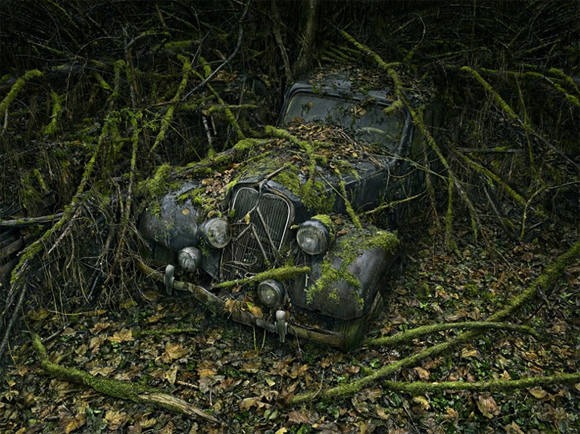
American-born, Paris-based photographer ↑Peter Lippman explores a world of stationary cars overtaken by nature in his series entitled ↑Paradise Parking. This personal project that was two years in the making captures abandoned cars from yesteryear that are overwhelmed by roots and leaves from its surrounding natural environment. The vehicles’ rusty, tarnished finish coupled with nature’s swarming shades of green and brown wrapping its extended limbs around the cars makes for an interestingly post-apocalyptic scene.
Global Knowledge, Traveling Technologies and Postcolonialism.
Perspectives on Science and Technology Studies in the Global South
↓Call for papers for a workshop at the Max Planck Institute for Social Anthropology in Halle/Saale, Germany, from 18 through 20 July 2012. Here’s a snippet:
As an interdisciplinary endeavour to study knowledge systems and technologies, Science and Technology Studies (STS) have become popular within the humanities and social sciences over the last three decades. However, most of the canon as well as recent scholarly work concentrate on Euro-American techno-science. Social scientists involved in STS focused mainly on the centres of western scientific knowledge production, thereby neglecting large parts of the world. While the relationship between technoscientific knowledge and postcolonial orders has been the subject of increasing discussion within the last two decades (Seth 2009), it is only recently that scholars have tried to establish a more sustained dialogue with postcolonial perspectives on science and technology (Harding 1998; Anderson 2002; Redfield 2002; Rottenburg 2009; Philip, Irani & Dourish 2011). In 2008, Richard Rottenburg, Trevor Pinch, Otto Sibum and Suman Seth organized a conference on Places of Knowledge: Relocating Science and Technology Studies at Cornell University. This workshop is a follow-up to this meeting. By focusing on the concept of the ‘Global South’ in conjunction with that of ‘postcolonialism’ we wish to draw attention to ever more globalizing dynamics of power, fashion, money or institutional problematizations. Accordingly, the workshop asserts the need to relocate STS by re-considering the interconnectedness of knowledge production, technology design and transfer, geopolitical categories and the particular issues, that different contexts produce. It is our contention that perspectives from the Global South may contribute not so much in describing nation states or specific regions in a historical moment, but enable us to better understand the interconnected processes that drive science and technology within a globalized world. We particularly call for contributions and participants that focus on non-classical STS contexts (i.e. the Global South). Contributions with case studies from Africa, Latin America and Asia are expected to challenge or at least to comment on existing methodological and theoretical concepts within STS.
In a way this is funny, at least to me. It was in Halle where I organized ↵my first workshop on cyberanthropology—at the ↑2005 biannual conference of the GAA. The campus of the university there is comparatively small. A flock of ancient and modern buildings right in the city’s center, nicely grouped around a sloping forum. The weather was fine, so on the first day everywhere in the forum groups of anthropologists were standing around, conference program in hand, discussing the upcoming panels and workshops. Back then only few people there knew who I was, and didn’t know how I look. So I could freely mingle and eavesdrop on the conversations. Somehow the workshop title ‘Cyberanthropology’ and the abstract had hit a nerve and there was quite some badmouthing like ‘That ain’t anthropology at all,’ or ‘Why did the GAA accept that?’ up to ‘Who does this guy think he is.’ … now, see above and look where we are today :-)
To be fair: the workshop was more than very well attended, full-house in one of the bigger halls actually. This shows that the badmouthing I overheard was not at all representative.

When I read some of the comments to this indie-game my breath caught, ↵because I feared I would have to launch a copyright lawsuit ;-) Anyway, since ↵Minecraft, ↑Antichamber is the indie-game I am looking most forward to. There’s a teaser trailer at the official website and 8.5 minutes of commented gameplay footage ↑at Kotaku. Head over and drool!

The above 3D-scene, called ‘Desert Lion,’ was done by Andrew March in 2004 and since then sat on my HDD. Andrew used the model of the Cougar ↑mech (which at least dates back to 2002, but you can still ↓download it) by Pawel Czarnecki—until today a legend within the scene—, the model of the ↑AMX-30 tank by Deespona, and nicely composed and rendered them within his own scene. Obviously the piece of art was created under the impression of the ↑Iraq War.
The picture immediately rung a chord within me back then, but somehow I never came around to posting it. Today I saw, ↑via Infocult, the ↑pictures of seven tank graveyards around the world and immediately ‘Desert Lion’ crept in front of my mental eye. The following two photographies were taken by ↑John Out and About on 30 April 2004 in Kuwait: